

Posted inHome


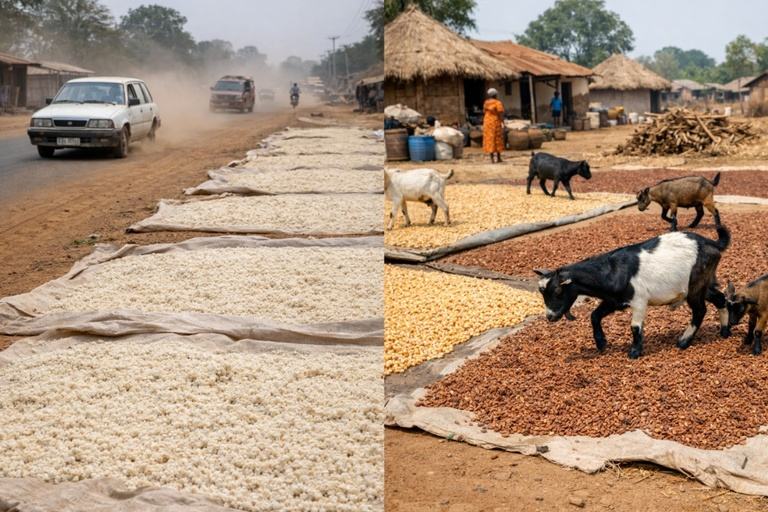
Food crops drying
Roadside Food Drying in Nigeria Raises Alarming Health Risks

Along Nigeria’s highways and rural roads, cassava, maize, rice, beans, pepper and melon seeds are routinely spread under the sun. While farmers see it as a cheap preservation method, health experts warn it poses serious public health risks.
From the South-West to the North-East, roadside drying has become normalised, turning busy transport corridors into open-air processing floors. Vehicles raise dust that settles directly on food, while animals roam freely across produce meant for markets and homes.
Environmental health experts say roadside dust is not harmless. It often contains oil residues, exhaust fumes and heavy metals, including lead, which contaminate food during drying. Washing later, they warn, cannot remove all pollutants.
Nutritionists also highlight the danger of animals walking on drying food, introducing bacteria, worms and faecal matter. Slow drying on bare ground encourages fungal growth, some of which produce aflatoxins — toxins linked to liver cancer, poor immunity and stunted growth in children.
Rice and beans are particularly vulnerable. Traders confirm that stones and gravel commonly enter grains during roadside drying, leading to consumer complaints, injuries and reduced market value.
Beyond health risks, roadside drying threatens road safety. Drivers report swerving to avoid food spilling onto highways, increasing accident risks and economic losses for farmers.
Medical professionals say hospitals are already feeling the impact, treating rising cases of diarrhoea, typhoid, intestinal worms and chronic stomach infections linked to unsafe food processing.
Experts stress that farmers are not careless but lack alternatives. Agricultural officers call for government-supported drying platforms, solar dryers and community processing centres.
In Niger State, authorities have begun acting. Through sensitisation programmes supported by IFAD and the Value Chain Development Programme, farmers are being trained and provided with tarps and cement floors.
Health experts say this model must go nationwide. Without support and enforcement, roadside drying will continue turning Nigeria’s staple foods into hidden carriers of disease.





Ab77bet – not my favorite, but hey, I won a few bucks! Could be better, could be worse. Take a look for yourself: ab77bet
WG777, heard some buzz about it. Gave it a spin, alright gameplay honestly. Could use a better design but the win rate is pretty decent. Worth a try maybe: wg777
Crazy 777 JILI, now we’re talking! Classic vibes. Got the app, easy to download and play. Won some, lost some but all in good fun. Link here: crazy 777 jili